Early Life and Education (1909 – 1930)
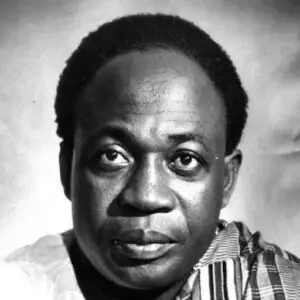
Kwame Nkrumah was born on 21st September 1909 in Nkroful, a small town in the Nzema area of the Western Region of Ghana (then the British Gold Coast). He was the only child of his mother, Madam Nyaniba, a retail trader, while his father was a goldsmith. Raised in a traditional Nzema family, young Nkrumah grew up in an environment that emphasized communal living, discipline, and education.
He started his education at the Catholic Mission School in Half Assini, where his intelligence and leadership qualities soon stood out. A devout Catholic in his early years, Nkrumah was baptized and briefly trained as a teacher and catechist, which reflected his deep interest in religion and learning.
Secondary and Teacher Training (1930 – 1935)
After completing his basic education, Nkrumah entered the Government Training College (now Achimota School) in Accra, where he trained as a teacher. His years at Achimota exposed him to progressive ideas, nationalism, and the early seeds of Pan-African thought.
He graduated in 1930 and taught in various schools in Elmina and Axim before becoming a headmaster at the Catholic primary school in Axim. At this stage, his ambition for higher learning and broader horizons began to grow.
Tertiary Education and Studies Abroad (1935 – 1945)
In 1935, Nkrumah traveled to the United States to pursue further studies. He enrolled at Lincoln University, Pennsylvania, where he earned a Bachelor of Arts in Economics and Sociology (1939), followed by a Bachelor of Theology (1942). He later obtained two master’s degrees from the University of Pennsylvania:
- MSc in Education (1942)
- MA in Philosophy (1943)
During his years in America, Nkrumah worked as a cleaner, dock worker, and dish washer to fund his studies. Despite hardship, he was deeply influenced by African-American leaders and movements such as Marcus Garvey, W.E.B. Du Bois, and the Harlem Renaissance. He also became active in student politics, founding the African Students’ Organization in the USA and Canada.
Life in Britain (1945 – 1947)
In 1945, Nkrumah moved to London, enrolling at the London School of Economics and later University College London. While in Britain, he became a co-founder of the Pan-African Federation and played a leading role in organizing the historic 5th Pan-African Congress in Manchester (1945), alongside George Padmore, Jomo Kenyatta, and other future African leaders.
This congress was pivotal in charting the way for African independence movements, and it cemented Nkrumah’s reputation as a rising Pan-African thinker and activist.
Religious and Spiritual Life
Nkrumah’s early Catholic background shaped his discipline and morality, but as he matured, he leaned towards a syncretic spiritual philosophy. He respected Christianity but was also influenced by African traditional beliefs and political spirituality. His famous phrase “Seek ye first the political kingdom, and all other things shall be added unto you” captured the fusion of faith and politics in his vision.
Return to the Gold Coast and Political Rise (1947 – 1951)
In 1947, Nkrumah was invited by Dr. J.B. Danquah and the United Gold Coast Convention (UGCC) to become its General Secretary. However, his radical, mass-based approach to politics soon clashed with the UGCC’s elite leadership.
In 1949, he broke away to form the Convention People’s Party (CPP), which championed the slogan “Self-Government Now!”. His ability to mobilize workers, farmers, students, and market women made him the most popular nationalist leader in the Gold Coast.
Arrested in 1950 for organizing “Positive Action” strikes and boycotts, he won a landslide electoral victory while still in prison in 1951, becoming Leader of Government Business.
Independence and Presidency (1957 – 1966)
On 6th March 1957, under Nkrumah’s leadership, the Gold Coast achieved independence and was renamed Ghana, the first sub-Saharan African country to break free from colonial rule. Nkrumah became the first Prime Minister and later, in 1960, the first President of Ghana when the country became a republic.
Achievements
- Built massive infrastructure: roads, schools, Tema Harbour, Akosombo Dam.
- Expanded education: introduced free and compulsory primary education.
- Championed Pan-Africanism: helped form the Organization of African Unity (OAU) in 1963.
- Advocated for African unity and independence across the continent.
- Industrialization drive: established factories, state enterprises, and housing projects.
Challenges and Downfall
- Economic strain due to ambitious industrial projects.
- Internal opposition and unrest.
- Increasing authoritarianism (one-party state declared in 1964).
- Overthrown by a military coup in February 1966 while on a peace mission to Vietnam.
Life in Exile and Death (1966 – 1972)
After the coup, Nkrumah lived in exile in Conakry, Guinea, as a guest of President Ahmed Sékou Touré, who made him Honorary Co-President of Guinea. Despite ill health, he continued to write extensively on African unity, neo-colonialism, and socialism.
He died on 27th April 1972 in Bucharest, Romania, after battling cancer. His body was later returned to Ghana and interred at Nkroful, before being reburied at the Kwame Nkrumah Mausoleum in Accra.
Family Life
Kwame Nkrumah married Fathia Rizk, an Egyptian Coptic Christian, in 1957. They had three children:
- Gamal Nkrumah (journalist)
- Samia Nkrumah (politician, former MP for Jomoro)
- Sekou Nkrumah (politician and activist)
Legacy
Kwame Nkrumah remains one of Africa’s greatest leaders and thinkers. His vision of a united, self-reliant Africa continues to inspire generations. His writings, such as “Africa Must Unite,” “Consciencism,” “Neo-Colonialism: The Last Stage of Imperialism,” and “The Autobiography of Kwame Nkrumah,” remain influential. He is celebrated globally as a Champion of Pan-Africanism, Founder of Modern Ghana, and Visionary Leader.